Blog Feed

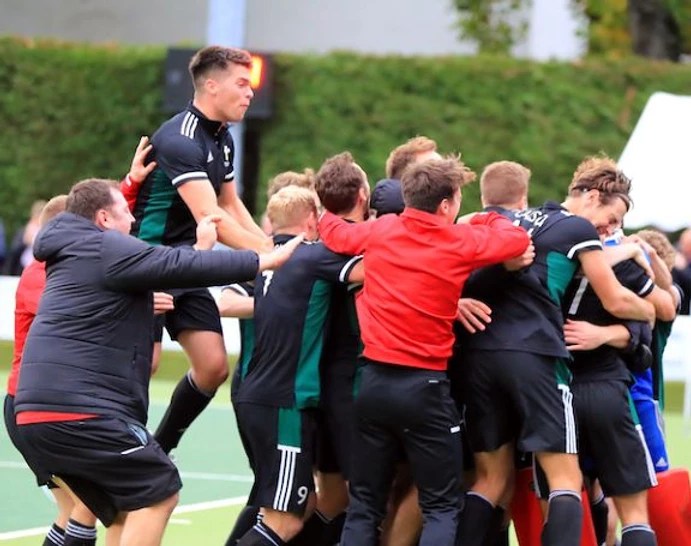
Wales qualify for Hockey World Cup after nail-biting semi-final shootout

Image credit – Ifron Bennett

Wales edged passed Ireland in a nervy encounter which ended one all after normal time, with the result being decided after Wales emerged victorious from the shootout. 

The game was a tale of two great defences, with both keepers on top form throughout the semi-final. 

The Welsh started on the back foot conceded a very early breakthrough. A rare lapse in concentration allowed Ireland to break within the first minute, with Michael Robson converting from close range to give his side an early boost. 

The first quarter was an even contest for the most part, with Wales struggling to capitalise on a flurry of short corners with ten minutes played. 

Rupert Shipperley was a bright spark as Wales chased an equaliser, but his dazzling run into the area came to nothing as his final ball failed to find another Welsh shirt. 

Ireland keeper Jamie Carr was alert in the start of the second quarter as he dealt with numerous shots to thwart the pressure and keep his team in the driver’s seat. 

Wales’ efforts were soon rewarded though courtesy of a stunning goal from Joseph Naughaty. With seemingly no passing options in front of him he went on a dazzling run, weaving in and out of Ireland’s defence before picking the perfect moment to fire home. 

The goal signalled a shift in momentum as Ireland fell onto the back foot for the remainder of the quarter. Naughaty would have doubled his tally for the afternoon on the stroke of half time had it not been for Carr’s heroic efforts in goal. 

The timing of the half-time interval suited Ireland as they came out all guns blazing in the third quarter, pulling no punches in an attempt to regain the lead. It was Wales’ turn to survive a storm of short corners with Daniel Kyriakides providing all the answers in goal. 

Wales were left with an uphill battle in the final minute of the third quarter when Luke Hawker was given a green card, however they were soon relieved when Shane O’Donoghue received a yellow for a worse infringement at the start of the fourth.  

It has to be said that Ireland certainly finished looking like the better side, but it was the same old story as they failed to capitalise on the number of short corners they received late on in the game. It would not be far-fetched to say that Wales hung on to survive the last few minutes. 

The shootout itself equalled the actual match in its’ tension and nervousness as it finished 2-1 to Wales. Goals from Rupert Shipperley and Jack Pritchard were enough to cancel out Sean Murrays strike to secure a historic win for the Welsh, which secured their World Cup place as well as their place in tomorrow’s final. Wales will face France in an all-important battle for the top seed. 

Lee Clayton & Sports Broadcasting During the Pandemic

The interview was uploaded in April 2020, and since then professional sport has resumed albeit with limited fan attendance in some areas and no fan attendance in others. For sports journalists it’s now much easier to find things to cover on their shows as sport is happening in a similar capacity to before the pandemic hit, whereas when this interview was published, live sport had been brought to a halt meaning broadcasters didn’t have the luxury of being able to keep audiences updated with live sport.

After watching this interview, I have learned that sports broadcasting needs to have an aura of positivity running throughout. I say this because Lee mentions a letter that he received from one of his listeners, which asked him to talk less about the news and current events whilst also telling him to keep up the good work in providing a positive piece of escapism. This shows what audiences really tune in for when it comes to media consumption, particularly in sport.

Three questions I would have asked in that interview are:

“The Cheltenham Races and other sporting events went ahead as planned, and many criticised the government for not postponing the events. What is your opinion on this matter? Should the events have proceeded as planned?”

“Do you think a financial plan should be put in place to protect sport at a lower level and to stop football clubs from being liquidated?”

“If sport does eventually go ahead without fans in attendance, how do you think this might affect the overall product and the viewing experience?”

If a follow-up interview with Lee Clayton was to happen today, two things would need to be researched in preparation. Firstly, research would need to be conducted into how Talksport managed to cover all of the sport that resumed over the summer. Thereafter, research would need to be conducted into the reception from fans on them being able to hear live sport being reported again, and also into the feedback that Talksport received on social media.

The Heavy Sacrifices of Female MMA Become Clear in new Inside the Cage Documentary

‘Inside the Cage: The Rise of Female Fighters’ follows presenter Annie Price as she takes an important behind-the-scenes look at what it takes to become the next rising star in the world of UK mixed martial arts.

The documentary is focused on three fighters: Molly McCann, Shanelle Dyer and Cory Mckenna, all of whom are at different levels within the sport and come from different backgrounds.

McCann is the first British woman to have recorded a victory in the pinnacle brand of MMA: The UFC. She shows Price the basic fundamentals of UFC training, instantly shedding light on the high-octane intensity of the sport before stepping into the cage itself.

The piece is built around interviews conducted with the three fighters, who share their stories about their motivations behind wanting to get into the sport and their aspirations within the industry.

McCann’s mentality changed after her mother, a struggling addict, managed to kick her addictions to benefit the lives of those around her, which is what motivates McCann to this day.

Dyer’s motivations are equally as dark as McCann’s. She knows that MMA keeps her off the streets and from winding down the wrong path, as she strives to earn enough money to provide a better life for herself and the rest of her family, in the hopes that they can move away from their area which is riddled with knife crime.

Mckenna’s story is more somewhat unexpected, as she went from being a straight A student to full-time fighter after she had finished her GCSE’s. When asked by Price on whether she thinks she’s missing out on her teenage years and partying, she replies: ‘If it doesn’t benefit me long term or help me achieve my goals then there’s no point wasting time on it is there’.

The documentary is available to watch on BBC iPlayer and is brilliant on portraying the grind that up-and-coming fighters have to go through in order to achieve their dreams of making it within the sport.

Lee Tomlin – The Elephant in The Room at Mick McCarthy’s Cardiff City

Across the 46 games they played, Cardiff City had quite the turbulent season. However, it was not too dissimilar to the previous campaign.

Both seasons started in lacklustre fashion with the squad arguably punching well below their weight in the league standings. Both seasons featured a change of manager in or around the halfway mark. Both manager changes resulted in a change of fortune in relation to the side’s league standings. Both relative successes were largely down to one key player.

The absence of the fans aside, one of the main differences between two campaigns is the contribution of the prolific playmaker that shone in the former season. That player is none other than Lee Tomlin.

Towards the tail end of last season, Tomlin suffered an injury at Craven Cottage when Cardiff faced Fulham in the second leg of their Play-Off semi-final. Further complications meant that Tomlin would struggle to regain fitness over the course of the season and he only featured five times for City in the league for Neil Harris, who was of course relieved of his managerial duties in early January.

Tomlin had a spell with the under-23 side where his veteran experience shone, but even as he was recalled to first team training and the hopes of seeing him contribute on the pitch grew, he never featured under Mick McCarthy.

It is undeniable that Tomlin’s playmaking expertise singlehandedly guided City to the top six last season, and that he could prove to be one of the Championship’s most creative midfielders when fully fit, even at the age of 32.

However, Mick McCarthy will look to bolster the squad and implement some fresh faces in time for the season ahead, which would mean shedding the dead wood within the squad. Despite his past glories and highlight reel worthy moments, Lee Tomlin would not be excluded from the chopping block.

Fans began to ask questions on how the former Bristol City number 10 struggled so severely to maintain matchday fitness, and they were not out of line to do so.

City showed how important a creative pivot is within their starting 11 considering Harry Wilson enjoyed a fruitful loan spell this campaign as he contributed to 18 league goals. However, an ageing Lee Tomlin will not be sufficient enough to fill this void as Wilson returns to Liverpool.

It has also been well documented how frustrated Tomlin can get when not involved in first team plans, as he was quick to vent his dismay when Neil Warnock regularly excluded him from the side during their Premier League spell.

With this in mind, it is apparent that Tomlin does not work best as a squad player and is more suited to being the main focal point of a team’s attack. However, as Cardiff look to mount another Play-Off push next season, it would not help their efforts if they had to rely on players that struggle to regain fitness within their starting 11.

The notion that Tomlin is passed his best is not one that has much weight or sense behind it; pace was never part of his game in the first place and a player’s technical prowess does not usually fade with age.

However, given Mick’s press-heavy, possession-devoid approach to games has struck a chord and turned City’s fortunes, it is vital that they attempt to cash in on the playmaker before his contract runs out.

Tomlin will go down as a fan favourite City player whenever he leaves and would undoubtedly be welcomed back to the city with open arms by the Bluebirds’ fanbase, but leaving now would be the best thing for both parties given the circumstances.

The Jonny Owen Interview & Podcast

The format of the 11-minute interview means that the questions come up as text on the screen rather than being asked audibly by an interviewer, meaning that Jonny Owen is the only one talking in the video. This puts the full focus of the video on him and what he has to say in response to the questions that are being asked, which I think enhances the interview.

Jonny Owen is a Welsh actor and producer who has appeared in shows such as My Family. He is perhaps even more known for producing the 2007 film The Aberfan Disaster, for which he won a bafta award. In this interview he is talking about his upcoming film The Three Kings

If I were to write a piece on this interview, the focus would be on Jonny comparing Bill Shankly to Jurgen Klopp, saying that “Klopp was the perfect fit for Liverpool and that dates back to Shankly. Shankly went straight into the kop and went ‘I’m one of you and you are one of me’”.

The 36-minute podcast on the other hand is targeting the general football fan, particularly fans of Scottish football, of an older generation as they talk about a generation that worked down the mines.

The questions being asked are a lot deeper and require a lot more thought for Jonny Owen in comparison to the other video, which is evident when comparing the run times of the two videos. The questions are more linked with deeper affiliations with clubs like Celtic and the story of the documentary.

The presence of the interviewer is vital in this video because it allows for more of a back and forth dynamic of dialogue rather than questions being answered in isolation, which allowed for better justification and understanding of Jonny’s answers and worked in this video’s favour.

EFL League Two Play-Offs: Can Newport County cross the line?

On Saturday, Newport County secured a Play-Off spot after grinding out a 1-1 draw against the relegated Southend United.

After thriving in the opening stages of the season, their league campaign was rocked by the departure of loanee’s Scott Twine and Brandon Cooper, both of whom had been recalled by their parent clubs and both of whom had established themselves as mainstays within the County starting 11.

They survived the subsequent mid-season lull as Flynn managed to galvanize the squad and guide them to secure fifth place in the league table, only missing out on automatic promotion to Bolton Wanderers by just six points.

Saturday’s result means that The Exiles are finally given another chance to avenge their loss in the 2019 Play-Off Final, where they narrowly missed out after extra time. But just how good are County’s chances of lifting the Play-Off final trophy?

The Exiles will be joined in the semi-final by Forest Green Rovers. Rovers have enjoyed yet another successful season as they head into the Play-Offs for the second time since being promoted to League Two in 2017, previously finishing fifth in the 2018/2019 season but failing to reach the Play-Off Final.

Having finished 6th this time around, Forest Green have benefited from the firepower of ex-County forward Jamille Matt who has registered 16 league goals to his name.

County have also failed to beat them in two attempts this season, with the two sides sharing the spoils in a 1-1 draw early in the season before Rovers picked up a two-nil victory at Rodney Parade.

In the other semi-final, Morecambe face off against Tranmere Rovers.

Morecambe have also asserted themselves as an attacking force to be reckoned with this season, finishing as the third top scoring side in the division. Playmaker Carlos Mendes Gomes and forward Cole Stockton heavily contributed to this as they flexed their metaphorical attacking muscles to register 15 goals and 13 goals respectively.

Newport did the league double over them this season, with their latter fixture gaining the attention of the football world after Kevin Ellison targeted his goal celebration at the dugout of Morecambe, a club where Ellison says he was mistreated as a player. County should fancy their chances against Morecambe should the teams face off in the Play-Off Final

Tranmere Rovers on the other hand are a familiar foe where County are concerned. The two sides clashed in the previously mentioned 2019 Play-Off final, where Tranmere were victorious over the ten men of Newport thanks to a Connor Jennings header in extra-time to break the hearts of The Exiles in attendance.

Both of their league fixtures between each other finished in a one nil win for the home side, showing that, similarly to 2019, not much would separate the two sides if they both advanced from their respective semi-final ties.

Newport will also be hoping that their captain Joss Labadie will be fit to start the first leg of the semi-final after he was brought off due to injury in their final game of the season. The midfielder tweeted that he was fine, but it is currently unclear whether the repercussions of the knock are more severe than expected.

Newport County’s first semi-final clash against Forest Green Rovers will take place on the 18th of May, and will air on Sky Sports.

MATCH REPORT: Cardiff City 1-1 Rotherham United – Bluebirds Break Millers’ Hearts With Late Marlon Pack Strike

Cardiff City confirmed Rotherham United’s return to League 1 with a late equaliser at the Cardiff City Stadium, despite a valiant effort from the visitors.

Rotherham exploded out of the starting blocks with a goal inside the opening ten minutes. The ball deflected upwards as the hosts cleared a cross and the ball fell to Lewis Wing, who struck the ball with a first-time volley from just over 20 yards out from goal.

The response could have been almost instant, with Harry Wilson threatening from a free kick in a similar position to the goal that sealed his hat-trick against Birmingham City in his previous outing. He hit the ball with venom but without the dip required to keep it on target.

Derby caused constant problems for Cardiff in the opening 20 mins with their intensity in the press off of the ball. Players like Marlon Pack and Ciaron Brown were consistently put under pressure to play the long ball early, which would almost always result in a change of possession as Jamal Blackman would easily gather the loose ball.

The Millers almost made it two from the first clear-cut chance of the match as a result of a corner kick. Ryan Giles’ delivery found veteran centre-back Richard Wood at the far post who should have done better with his headed effort which just skewed wide.

The visitors had another great chance on the half-hour mark. The two forwards combined as Smith broke free down the left flank and did superbly to find Matt Crooks who had the opportunity to double the lead from just beyond the penalty spot. The pressure from Curtis Nelson meant that Crooks opened his foot too much when striking, meaning the ball fizzled wide for a goal-kick.

Angus McDonald also could have put his name on the scoresheet, with his half-volleyed effort bringing out an excellent reaction save from Cardiff keeper Dillon Phillips.

The first half belonged to the visitors, who suffocated Cardiff City into making errors both on the ball and off the ball. The pattern of play made it look as though there were two or three more Rotherham shirts on the field than Cardiff City shirts.

The Bluebirds slowly started to impose themselves as the half-time whistle neared, however they were unable to find the ball that would unlock the Millers’ back line with any significance or conviction.

Rotherham manager Paul Warne would have been slightly disappointed in the fact that his side entered the interval just the one goal ahead, as Cardiff’s first half perfectly resembled that of a team with nothing to play for.

Cardiff showed their intentions to make the afternoon more difficult for Rotherham as they started the second half brightly. The introduction of Mark Harris off of the bench for Ruben Colwill added a level of composure and urgency to the forward play from the hosts.

A break-away ball from Leandro Bacuna found Harry Wilson, who was able to cut the ball back to Kieffer Moore who made a late run at the edge of the box. His effort just sailed above the bar as he leaned back whilst striking the ball first time.

The Welsh duo of Wilson and Moore mustered up another opportunity as they broke away minutes later. The ball was played to Moore from Wilson arguably a few seconds too late, with the former’s shot being blocked by McDonald.

Perry Ng nearly opened his account for the Bluebirds on the hour mark. The ball entered his path at the edge of the box after a wayward ball in from substitute Josh Murphy. Ng’s subsequent left footed effort was deflected out for a corner kick which amounted to nothing.

Wing was left looking up to the heavens as he missed arguably the best chance of the game to double his side’s lead.

The Millers found themselves in a three-on-two attacking situation as Crooks charged forward with the ball. He cut back to Wing on the edge of the area who was required to strike the ball first time due to the pace at which he was surging forward.

 Due to the treacherous conditions he slipped upon making contact with the ball as it dribbled well wide of the goal.

He continued to cause trouble for Dillon Phillips in the Cardiff City net as his curling effort came inches from nestling into the top corner in the 80th minute. Despite all the huffing and puffing, Rotherham could not seem to find the second goal at that stage.

The Bluebirds broke Rotherham United hearts in the 87th minute as Marlon Pack registered an equaliser. The long ball was poorly dealt with by Rotherham who let Marlon Pack hit it at the edge of the area. The former Bristol City midfielder placed the ball into the bottom corner with complete composure.

The result sealed Rotherham’s relegation as Derby County managed to salvage a point against Sheffield Wednesday, who were also relegated.

The Importance of International Women’s Day

March 8th is known worldwide as International Women’s Day (IWD); a day where the world recognises the importance of women across all industries and a day where everyone comes together to show solidarity and support for women’s rights.

The growing power of social media means there is a growing responsibility for us as a society to voice our appreciation and support for women all across the world, which is why the day is so important. It is a day to educate and enlighten those who are either uneducated or ignorant on the matter.

One of the main arguments against having an International Women’s Day that people use online goes somewhere along the lines of ‘but we don’t have international men’s day, so why do we need a day for women?’, and whilst some may argue that from a genuine place of innocence, the question itself misses the point.

Men were never historically discriminated against or limited in what they could do at the hands of society, whereas women were, and in many countries, still are.

Olympic silver medallist Morgan Lake praises IWD for what it does to eliminate stigmas about women in relation to sport. She says how she was lucky to have female sporting idols such as Jessica Ennis-Hill, and how IWD shines a spotlight on women’s sport in particular, which is crucial in encouraging and inspiring girls to pursue their dreams within the world of sport.

BT Sport pundit Sarra Elgan shares a similar message, noting how important it is that women and girls take an interest in order to turn these female athletes into the role medals that girls desperately need, which in turn increases the exposure of women’s sport and gives it the credibility and appreciation that it has always deserved.

Design a site like this with WordPress.com
Get started